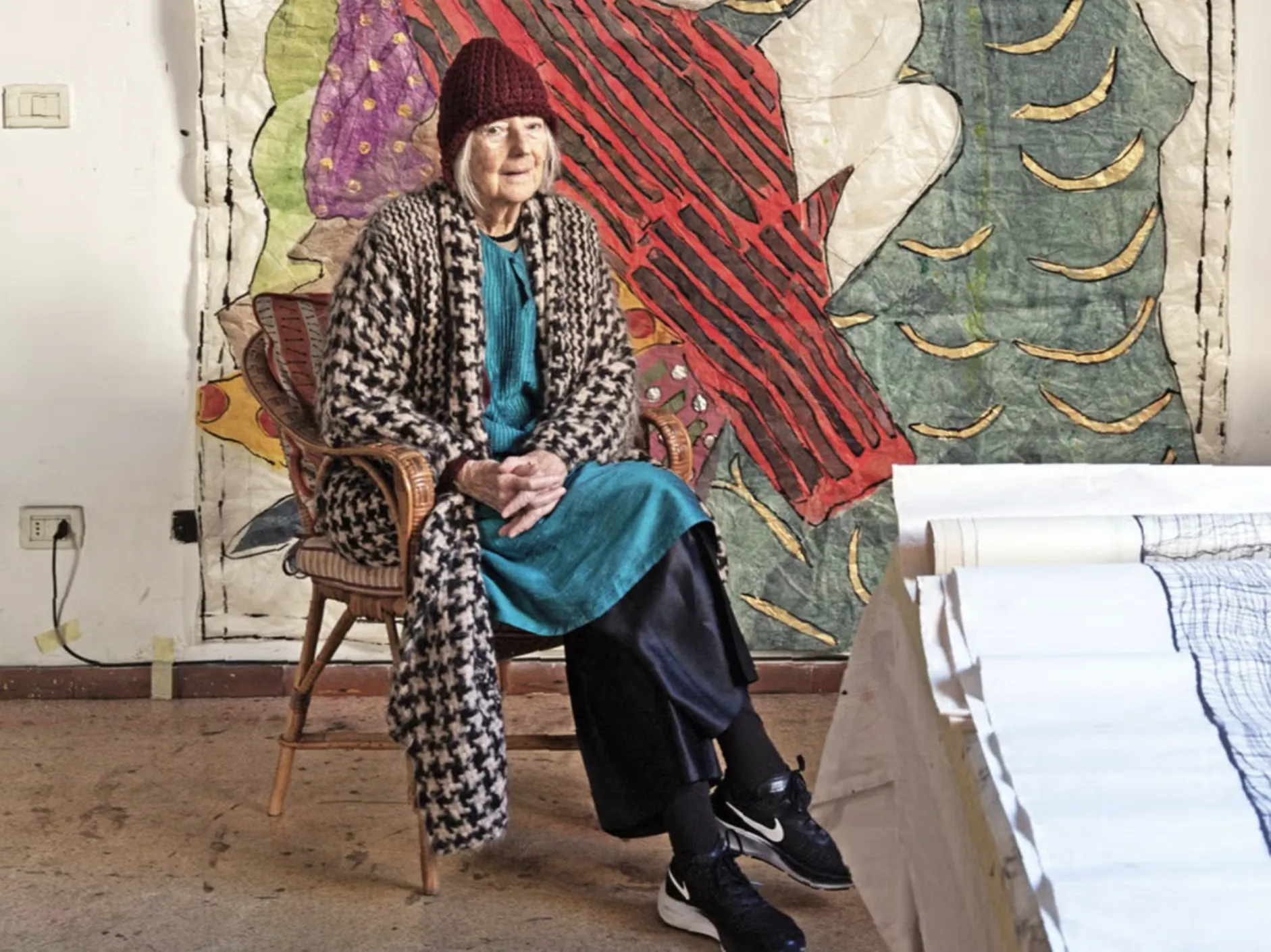
Isabella Ducrot
-
Biography
 Photo: Albrecht Fuchs
Born 1931 in Naples, Italy
Lives and works in Rome, Italy
Isabella Ducrot’s work is rooted in a close observation of everyday life, exploring how seemingly simple forms and images can hold layers of memory and meaning. Through drawing, painting, and writing, she creates intimate works that reflect on time, perception, and the traces of lived experience.
In recent years, Ducrot has gained remarkable international recognition, after having been introduced to the international art scene at the age of 88. In December 2026, Museo Madre, Naples, will devote a major retrospective to Ducrot, curated by Adam Weinberg, which will subsequently travel to the Astrup Fearnley Museum, Oslo, and MoMA PS1, New York, in 2027–28.
Her practice has been the subject of significant institutional presentations, including the Museo della Civiltà, Rome; Espoo Museum of Modern Art; Museo Archeologico Nazionale, Naples; Galleria Nazionale d’Arte Moderna e Contemporanea, Rome; and MAXXI a Taormina. Among her earlier milestones was Ducrot’s participation in the Venice Biennale in 1993 and 2011. In 2022, her large-scale installation Omaggio a Mishima (Homage to Mishima) was presented in the Unlimited sector of Art Basel.
The year 2024 marked an important chapter for Ducrot in France, with a comprehensive solo exhibition at Le Consortium Museum, Dijon, and a collaboration with Dior, for which she created the monumental scenography for its Spring Haute Couture show.
Ducrot’s work is held in prominent collections, including the Astrup Fearnley Museum, Oslo; Cranford Collection, London; Espoo Museum of Modern Art; Galleria Nazionale d’Arte Moderna e Contemporanea, Rome; Le Consortium Museum, Dijon; MAMCO, Geneva; MAXXI Museo, Rome; and Munchmuseet, Oslo, among others.
She is also a dedicated author and has published numerous books, including La Matassa primordiale (2026); Animali Recenti (2025); Stoffe (2022); La vita femminile (2021); La stoffa a quadri (2019); Suonno. Il sonno e il sogno nella canzone napoletana (2012); Fallaste Corazón (2012); Pensiero religioso ed elettricità (2011); La Matassa Primordale (2008); and Bianca di Pelle (1995).
-
-
-
Isabella Ducrot
Blue Line, 2025Pigments and fabric on Japan paper
174 x 99 cm
68.5 x 39 inches -
News
-
-
WorksOpen a larger version of the following image in a popup:
Installationview, Isabella Ducrot "Big Aura", Capitain Petzel, Berlin, 23 November 2019 - 11 January 2020
Isabella Ducrot
Abito, 2016Mixed media on silk183 x 147 cm
72.1 x 57.9 inchesB-IDUCROT-.19-0002Further images
Repetition is the subject and primary theme in many of Ducrot’s artworks. In the East, repetitive elements are an end in itself, the centre of emotion. In the West, they...Repetition is the subject and primary theme in many of Ducrot’s artworks. In the East, repetitive elements are an end in itself, the centre of emotion. In the West, they are declared to be ‘decoration’, which is something always somewhat subordinate, framing an event or theme. In Ducrot’s work, the repetitive element becomes the object of representation, the protagonist of the image.The rhythm of life, the heartbeat, is expressed by repetitive elements, which are, not coincidentally, also musical elements. This is a celebration of virtual infinity.Literature
Oliver Koerner von Gustorf, Gewebe aus Geschichte, Architectural Digest Deutschland, Mai 2020, p. 94.
Publications
Isabella Ducrot, Marcello Panni, Mishima, diagonale/librogalleria, Rome 2016, p. 3.Exhibitions-
Isabella Ducrot
Altri Fiori 28 February — 12 April 2025Explore -
25 for 2025
11 January — 15 February 2025Explore -
Sweet Sixteen
Celebrating 16 years of Capitain Petzel 7 June — 3 August 2024On the occasion of Capitain Petzel’s sixteenth anniversary, the gallery is excited to present Sweet Sixteen , a group exhibition celebrating the artists who have been integral to its program...Explore -
omelette papier
15 January — 5 March 2022Karla Black, Andrea Bowers, Joe Bradley, Isabella Ducrot, Jadé Fadojutimi, Hadi Fallahpisheh, Anna Gaskell, Georgia Gardner Gray, Stefanie Heinze, Charline von Heyl, Sanya Kantarovsky, Maria Lassnig, Marcel Odenbach, Pieter Schoolwerth,...Explore -
Studio Exhibition: Isabella Ducrot
Erotici 26 February — 17 April 2021Capitain Petzel is pleased to announce a new exhibition by Isabella Ducrot in the Studio space of the gallery. The exhibition will be centered around the artist’s sensual drawings, which...Explore -
Seven-Up
An art fair presentation 24 October — 7 November 2020Capitain Petzel is pleased to announce Seven-Up , a presentation of works by seven artists initially conceived to be shown at this year's FIAC at the Grand Palais in Paris....Explore -
Isabella Ducrot
Big Aura 23 November 2019 — 11 January 2020Through her extensive travels in Asia, Isabella Ducrot has assembled a sublime collection of antique textiles, originating primarily from India, China, Tibet and Afghanistan. Fascinated by the presence of rhythm...Explore
External ExhibitionsTrue Colors Textiles: motion, colors, and identities, 2025
MAXXI L'Aquila - Museo nazionale delle arti del XXI secolo, Province of L'Aquila
Press-
Die Zeit: "Ich war noch nie so glücklich in meinem Leben" (Isabella Ducrot)
Christoph Amend, 22 April 2026 -
marie claire: "Tessuti ad arte: il racconto dell'artista Isabella Ducrot"
Mariachiara Di Trapani, 15 December 2025 -
REPUBLIK: "Ü90: Party im Palazzo" (Isabella Ducrot)
Marie-Sophie Müller, 29 November 2025 -
Monocle: "The art of ageing: Inside the studios of seven in-demand artists in their eighties and nineties" (Isabella Ducrot)
Claudia Jacob, 22 October 2025 -
Frankfurter Allgemeine: "Wenn wir nutzlos für die Natur geworden sind, sind Frauen endlich frei" (Isabella Ducrot)
21 September 2025 -
Ocula: "‘My Story Is About What I Have Not Done’: Isabella Ducrot on Writing"
Annabel Downes, 5 August 2025 -
OBSERVER: "Isabella Ducrot’s Practice Remains Rooted in the Quiet Power of Materials"
Elisa Carollo, 7 July 2025 -
Artsy: "At 94, Isabella Ducrot Is Gaining Overdue Recognition for Her Tender Paintings"
Maxwell Rabb, 20 June 2025 -
Whitewall: "Visiting Isabella Ducrot’s Studio: Where Fabric Meets Emotion in Rome"
Michael Klug, 30 May 2025 -
Tagesspiegel: "Keine Angst vor Dekorativem: Die Blumenbilder von Isabella Ducrot"
Dorothea Zwirner, 4 April 2025 -
Weltkunst: "Ist das Leben nicht schön?" (Isabella Ducrot)
Annabelle Hirsch, 28 March 2025 -
ArtReview: "Isabella Ducrot and the Textile Renaissance"
Ana Vukadin, 3 February 2025 -
Artnet: "At 94, Artist Isabella Ducrot Is a Rising Star"
Jo Lawson-Tancred, 29 January 2025 -
Artsy: "The Most Influential Artists of 2024" (Isabella Ducrot)
Artsy Editorial, 19 December 2024 -
Electra Magazine: "Isabella Ducrot: Textile Characters"
Leander Gussmann, 1 December 2024 -
The New Yorker: "An Artist Flowering in Her Nineties"
Rebecca Mead, 22 July 2024 -
Monopol: "Dior und die Künstlerinnen Mehr als nur Couture-Kulisse" (Isabella Ducrot)
Leonie Wessel, 29 January 2024 -
Artnet: "See the 93-Year-Old Textile Artist Isabella Ducrot’s Monumental Scenography for Dior Couture"
Lee Carter, 23 January 2024 -
Artforum: "Isabella Ducrot"
23 June 2023 -
Frieze: ''Isabella Ducrot's Practice Is Free From Rules''
Ana Vukadin, 24 March 2023
Publications-

Isabella Ducrot
Suonno, Quodlibet, 2026 Isabella Ducrot, 2026Paperback, 72 pagesRead more
Publisher: Quodlibet
ISBN: 9788822925879
Dimensions: 120x182 mm -

Isabella Ducrot
Isabella Ducrot: A Retrospective, Hatje Cantz Verlag, 2026 2026Hardcover, 360 pagesRead more
Publisher: Hatje Cantz Verlag
ISBN: 978-3-7757-6322-6
Dimensions: 245mm x 305mm -

Isabella Ducrot
Recent Animals, Quodlibet, 2025 2025Softcover, 96 pagesRead more
Publisher: Quodlibet
ISBN: 9788822923813
Dimensions: 120x182 mm -

Isabella Ducrot
Isabella Ducrot. Profusione, Le Consortium and Les Presses du Réel, 2025 2025Hardcover, 192 pagesRead more
Publisher: Le Consortium and Les Presses du Reel
ISBN: 9782378965990 -

Isabella Ducrot
Isabella Ducrot. Tessere è umano, 2024 Anna Mattirolo, Andrea Viliani, 2024Paperback with flaps, 64 pagesRead more
Publisher: Electra, Rome
ISBN: 9788892827028
Dimensions: 15x23 cm -

Isabella Ducrot
Stoffe, 2023 Isabella Ducrot, 2023Hardcover, 580 pagesRead more
Publisher: Quodlibet
ISBN: 9788822906724
Dimensions: 16.7 x 24 cm -

Isabella Ducrot
Tendernesses, 2022 2022HardcoverRead more
Publisher: Galerie Gisela Capitain Cologne -

Isabella Ducrot
I ventidue luoghi dello spirito, 2022 2022 Read more -

Isabella Ducrot
Women’s Life, 2021 2021 Read more -

Isabella Ducrot
Eros, Galerie Gisela Capitain, Cologne, 2020 2020 Read more -

Isabella Ducrot
The Checkered Cloth, Quodlibet, 2019 2019Softcover, 96 pagesRead more
Publisher: Quodlibet
ISBN: 9788822903822
Dimensions: 120x182 mm -

Isabella Ducrot
Mishima – Banjo, 2017 2017SoftcoverRead more
Publisher: diagonale/librogalleria -

Isabella Ducrot
Text on Textile, 2013 2013Paperback with dust jacket, 26 pagesRead more
Publisher: Sylph Editions
ISBN: 0955296366
Dimensions: 16 x 24 cm -

Isabella Ducrot
Ricordo della Terra, 2002 2002 Read more
Isabella Ducrot: Near to Happiness
Touring a 16th-Century Italian Palace: Isabella Ducrot's Private Art Collection | The World of Interiors
Isabella Ducrot's Studio | Frieze Masters 2024
Request more information