Monica Bonvicini
-

-
Since the mid-1990s Monica Bonvicini has been exploring political, social, and institutional situations and their impact on society, as well as on the conditions of artistic production. Her work is direct, merciless, political, and not without a dry sense of humor. In the process, she focuses on the relationship between architecture, gender roles, control mechanisms, and devices of power.
– Axel Köhne, Curator, Belvedere 21
-
-
-
-
-
-
-
-
-
-
News
-
Monica Bonvicini, Zoe Leonard, Matt Mullican
'ARTISTS AGAINST THE BOMB' (Group Show), MoMA PS1, New York
10 September 2026 – 8 February 2027 10 September 2026ARTISTS AGAINST THE BOMB is a traveling exhibition of posters that advocates for universal nuclear disarmament. It comprises more than 250 historical and newly commissioned...Read more -
Karla Black, Barbara Bloom, Monica Bonvicini, Maria Brunner, Isabella Ducrot, Georg Herold, Charline von Heyl, Zoe Leonard, Laura Owens, Tobias Pils, Stephen Prina, Monika Sosnowska, Christopher Williams
'40 Years Galerie Gisela Capitain' (Group Show), Galerie Gisela Capitain, Cologne
September 4 – October 24, 2026 4 September 2026As part of the 40th anniversary, Galerie Gisela Capitain is pleased to announce a group exhibition presenting works from the gallery's history. Including works by:...Read more -
Monica Bonvicini
'GROSSE BUCHSTABEN, GRELLE FARBEN' (Group Show), Kunsthalle Emden
August 15, 2026 – February 28, 2027 15 August 2026Letters, words, sentences: In contemporary painting, they not only carry literal meaning but can also become independent pictorial motifs. The Kunsthalle Emden is dedicating a...Read more -
Monica Bonvicini
'Glasstress 2026' (Group Show), Palazzo Ca’ Tron, Venice & Berengo Art Space, Murano
July 12 – November 22, 2026 12 July 2026Following its most recent Venetian edition in 2024, GLASSTRESS returns to the Venetian lagoon. Conceived by Adriano Berengo in 2009 as a collateral event of...Read more -
Monica Bonvicini
'Power is Fragile' (Group Show), Schaudepot Sammlung Wemhöner, Herford
July 5, 2026 – November 1, 2026 5 July 2026With the exhibition POWER IS FRAGILE, the Wemhöner Collection’s Viewing Depot opens its spaces to the public for the first time. The exhibition brings together...Read more -
Monica Bonvicini, Maria Lassnig
'Shared/Divided Views. Kunsthalle Bielefeld x KiCo Collection' (Group Show), Kunsthalle Bielefeld
July 4 – October 2, 2026 4 July 2026What happens when we share – ideas, spaces, responsibility? With “Shared Views”, the Kunsthalle Bielefeld is opening a comprehensive, two-part exhibition project that focuses on...Read more -
Monica Bonvicini
'A Thousand Times Berlin' (Collection Display), Hamburger Bahnhof – Nationalgalerie der Gegenwart
From June 12, 2026 12 June 2026Berlin is a place of ongoing movement and negotiation, where artistic, political, and migratory trajectories intersect. For its 30th anniversary, Hamburger Bahnhof presents its new...Read more -
Monica Bonvicini
'The World Seen Anew' (Group Show), FOLTA Collection, Wrocław
June 5 – November 30, 2026 5 June 2026The inaugural exhibition of the FOLTA Collection is an invitation to trade perspectives – to look at art not as a collection of individual works,...Read more -
Monica Bonvicini
'Body in Motion' (Group Show), Fondazione Bonollo, Vicenza
May 23 – November 7, 2026 23 May 2026Selected from the Bonollo collection, the works on view explore the body as a means of relation and an instrument for investigating human existence. Long...Read more -
Monica Bonvicini
'Respekt!' (Group Show), Große Kunstschau, Worpswede
February 7 – November 11, 2026 7 February 2026Paula Modersohn-Becker often painted women from rural backgrounds or from the poorhouse in Worpswede. Her works reveal her intense engagement with this situation. One senses...Read more -
Monica Bonvicini
'Come Run With Me', Pinacoteca Agnelli, Turin
From October 31, 2024 31 October 2024The environmental neon installation Come Run With Me, commissioned specifically for the 30-meter-long South Parabolic Track 500, transforms the space into an exhortation of monumental...Read more
-
-
WorksOpen a larger version of the following image in a popup:
Ph: Simon Vogel
Open a larger version of the following image in a popup:
Ph: Simon Vogel
Open a larger version of the following image in a popup:
Ph: Simon Vogel
Open a larger version of the following image in a popup:
Ph: Simon Vogel
Open a larger version of the following image in a popup:
Ph: Simon Vogel
Open a larger version of the following image in a popup:
Ph: Simon Vogel
Open a larger version of the following image in a popup:
Installation view, Monica Bonvicini, & Liberation, Galerie Gisela Capitain Petzel, Cologne, 2024
Open a larger version of the following image in a popup:
Installation view, Monica Bonvicini, & Liberation, Galerie Gisela Capitain Petzel, Cologne, 2024
Open a larger version of the following image in a popup:
Ph: Simon Vogel
Monica Bonvicini
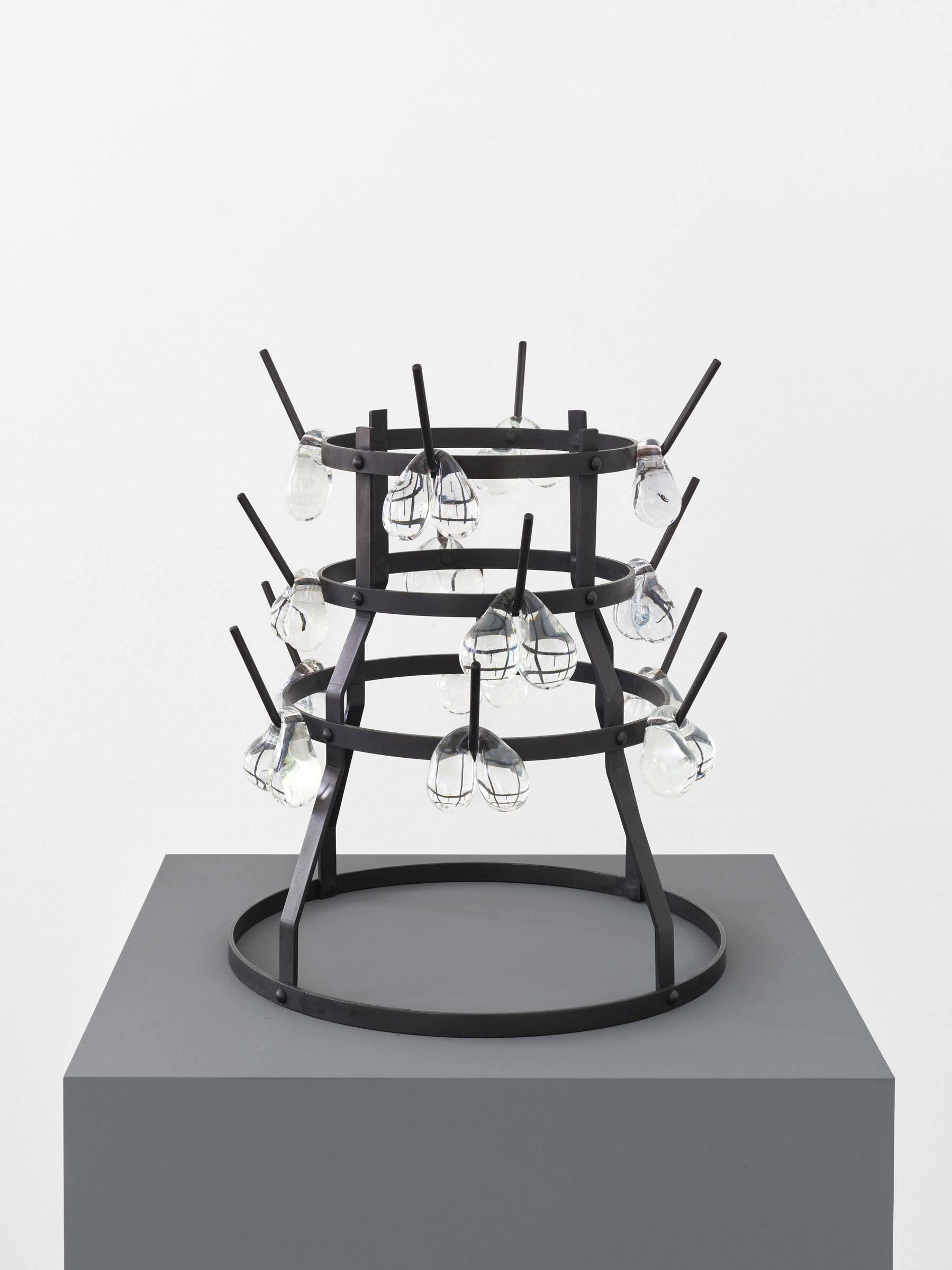
Fleurs du Mal (un couple), 2024Bronze, glass60 x 60 x 60 cm
23.6 x 23.6 x 23.6 inchesB-MBONVICINI-.24-0004Further images
-
(View a larger image of thumbnail 1
)

-
(View a larger image of thumbnail 2
)

-
(View a larger image of thumbnail 3
)

-
(View a larger image of thumbnail 4
)

-
(View a larger image of thumbnail 5
)

-
(View a larger image of thumbnail 6
)

-
(View a larger image of thumbnail 7
)

-
(View a larger image of thumbnail 8
)

-
(View a larger image of thumbnail 9
)

Monica Bonvicini's Fleurs du Mal (un couple) engages in a dialogue with Marcel Duchamp's iconic Bottle Rack (1914), creating a witty and provocative counter-vision. By casting her sculptures in bronze...Monica Bonvicini's Fleurs du Mal (un couple) engages in a dialogue with
Marcel Duchamp's iconic Bottle Rack (1914), creating a witty and provocative
counter-vision. By casting her sculptures in bronze and pairing them with
handmade glass objects, Bonvicini reinterprets Duchamp’s readymade and
its Freudian implications of male potency and masculinity. This approach
challenges traditional notions of desire, pleasure, and control.
In Bonvicini's oeuvre, the interplay of words is crucial to their conceptual
impact. The expression „on the rack“ conjures images of suffering and
anxiety, while the sculpture Fleurs du Mal (un couple) introduces a wry
connection. This wordplay highlights the afflicted status of the glass objects,
suspended from spikes like wilted flowers or mollusks, symbolizing the
decay of contemporary society. These objects symbolize not just physical
decay but also a deeper societal malaise, including the notion of fractured
masculinity.Exhibitions
Monica Bonvicini, & Liberation, Galerie Gisela Capitain Petzel, Cologne, 2024Exhibitions-
Monica Bonvicini
It is Night Outside 1 May — 7 June 2025Capitain Petzel is pleased to present It is Night Outside , Monica Bonvicini’s first solo exhibition with the gallery as part of Gallery Weekend Berlin. Spanning all three levels of...Explore -
25 for 2025
11 January — 15 February 2025Explore -
Non-Specific Objects
Nairy Baghramian, Barbara Bloom, Monica Bonvicini, David Douard, Nikita Gale, Sanya Kantarovsky, Kristina Nagel, Jack O’Brien, Sin Wai Kin, Alina Szapocznikow, Franz West 20 January — 24 February 2024Capitain Petzel is pleased to announce the group exhibition Non-Specific Objects . The title of the exhibition acts as a counterpoint to the ideas expressed in Donald Judd’s canonical 1964...Explore
External ExhibitionsMonica Bonvicini, Come Run With Me, 2024
Pinacoteca Agnelli, Turin
Press-
La Stampa: "Monica Bonvicini: nell’arte ci vuole sarcasmo, senza restiamo deficienti. L’AI? Come il cartongesso" (Monica Bonvicini: Sarcasm is essential in art; without it, we're just idiots. AI? Like plasterboard.)
Giulia Zonca, 28 October 2025 -
Il Giornale dell'Arte: "Premio Diana Bracco - Imprenditrici ad arte Terza edizione. MONICA BONVICINI" (Diana Bracco Award - Female Entrepreneurs in Art, Third Edition. Monica Bonvicini)
Monica Trigona, 15 October 2025 -
Plaster Magazine: "Monica Bonvicini: art without limits"
Harriet Lloyd-Smith, 3 September 2025 -
Monopol: "Der gute, alte Sex-Appeal""
Oliver Koerner von Gustorf, 7 May 2025 -
Berliner Zeitung: "Diese 8 Ausstellungen sollte man beim Gallery Weekend Berlin nicht verpassen!" (Monica Bonvicini)
Ingeborg Ruthe, Timo Feldhaus, 30 April 2025 -
Frieze: "The Best Shows to See in Berlin Right Now" (Monica Bonvicini)
Emily May, 29 April 2025 -
Monopol: "Spaziergänge zum Gallery Weekend. Wohin in Mitte?" (Monica Bonvicini)
Oliver Koerner von Gustorf, 26 April 2025 -
Berlin Art Link: "Monica Bonvicini"
Annalisa Giacinti, 23 August 2024 -
Tagesspiegel: "Eine Arche Noah für Venedig: Große Kunst aus Glas bei der 60. Biennale" (Monica Bonvicini)
Rüdiger Schaper, 9 June 2024 -
ArtReview: "Delinquent Bodies, Non-Specific Objects"
Jasmine Reimer, 26 April 2024 -
Berlin Art Link: "Challenging Bodily Norms in ‘Non-Specific Objects’"
Nadia Egan, 9 February 2024 -
Wallpaper Magazine: Monica Bonvicini ‘I do You’ review: bondage, mirrors and feminist takes on masculine architecture
Emily McDermott, 25 April 2023 -
Mousse Magazine: "Monica Bonvicini “I do You” at Neue Nationalgalerie, Berlin"
Ana Teixeira Pinto, 7 March 2023 -
Artnet: "Monica Bonvicini’s Feminist House of Mirrors Upends the Masculine Architecture of Berlin’s Neue Nationalgalerie"
Kate Brown, 24 November 2022 -
Berlin Art Link: "Domestic Rituals: An Interview with Monica Bonvicini"
Lucia Longhi, 1 October 2021 -
Monopol Magazin: "Monica Bonvicini in Bielefeld, Ein subtiler Tritt unter die Gürtellinie"
Jens Bülskämper, 13 March 2021 -
ArtReview: "Monica Bonvicini: her hand around the room"
Laura Smith, 15 March 2017 -
Flash Art: "Features: Monica Bonvicini"
Massimiliano Gioni, 20 December 2016
Publications-

Monica Bonvicini
Breach of Decor, Cultural Institution Gallery Kula, 2024 2024Softcover, 70 pagesRead more
Publisher: Cultural Institution Gallery Kula
ISBN: 978-953-7412-84-5 -

Monica Bonvicini
As Walls Keep Shifting, Kunsthaus Graz, Austria and Kunst Museum Winterthur, Switzerland, 2023 Texts by Konrad Bitterli, Monica Bonvicini, Jacob Fabricius, Katia Huemer, Hans Ulrich Obrist, Samuele Piazza, Barbara Steiner, Elena Zanichelli, 2023Softback, 544 pagesRead more
Publisher: Walter Koenig
ISBN: 9783753303086 -

Monica Bonvicini
I do You, Neue Nationalgalerie, 2023 2023Hardcover, 176 pagesRead more
Publisher: DISTANZ Verlag GmbH
ISBN: 978-3-95476-506-5 -

Monica Bonvicini
HOT LIKE HELL, Kunsthalle Bielefeld, 2021 2021softcover with flaps, 224 pages, 100 illustrations pagesRead more
Publisher: Snoeck Verlagsgesellschaft mbH
ISBN: 978-3-86442-336-9 -

Monica Bonvicini
I CANNOT HIDE MY ANGER, Belvedere 21, Vienna, 2019 2019 Read more -

Monica Bonvicini
Monica Bonvicini, Berlinische Galerie, 2017 2017Hardcover, 176 pages, 86 illustrations pagesRead more
Publisher: Kerber Verlag, Bielefeld
ISBN: 978-3-7356-0388-3 -

Monica Bonvicini
Monica Bonvicini, Phaidon Press, London, 2014 2014Paperback, 160 pages, 200 illustrations pagesRead more
Publisher: Phaidon Press, London
ISBN: 978-0-7148-6705-2 -

Monica Bonvicini
Monica Bonvicini – Disegni, Museum Abteiberg Mönchengladbach and the Deichtorhallen Hamburg/Sammlung Falckenberg, 2012 2012 Read more -

Monica Bonvicini
A BLACK HOLE OF NEEDS, HOPES AND AMBITIONS, Centro de Arte Contemporáneo de Málaga, 2011 2011Softcover, 125 pagesRead more
Publisher: Gestión Cultural y Comunicácion – CAC Málaga, Málaga
ISBN: 978-84-96159-99-0 -

Monica Bonvicini
MONICA BONVICINI, Städtische Galerie im Lenbachhaus und Kunstbau, München and Kunstmuseum Basel, Museum für Gegenwartskunst, 2009 2009Hardcover, 79 pages, 40 illustrations pagesRead more
Publisher: DuMont, Cologne
ISBN: 978-3-8321-9220-4 -

Monica Bonvicini
THIS HAMMER MEANS BUSINESS, Verlag der Buchhandlung Walther König, Cologne, 2009 2009Softcover, 160 pagesRead more
Publisher: Verlag der Buchhandlung Walther König, Cologne
ISBN: 975-3-86560-718-8 -

Monica Bonvicini
BOTH ENDS, Kunsthalle Fridericianum, Kassel, 2004 2004Softcover, 167 pages, 106 illustrations pagesRead more
Publisher: Verlag der Buchhandlung Walther König, Cologne
ISBN: 978-2-86560-873-4 -

Monica Bonvicini
EternMale, Kunsthaus Glarus, Centre d’édition contemporaine, Geneva, 2002 2002Artist's Book, 13 sheets of digital printed paper, metal spiral, 82 x 62 cm pagesRead more
Publisher: Kunsthaus Glarus, Centre d’édition contemporaine, Geneva -

Monica Bonvicini
KILL YOUR FATHER, Artist’s book, 2002 2002Softcover, 126 pagesRead more -

Monica Bonvicini
Scream & Shake, Le Magasin – Centre National d’Art Contemporain, Grenoble and Kunst-Werke, Berlin, 2001 2001Softcover, 88 pages, 43 illustrations pagesRead more
Publisher: Le Magasin – Centre National d’Art Contemporain, Grenoble
ISBN: 978-2906732728 -

Monica Bonvicini
What Does Your Wife / Girlfriend Think of Your Rough And Dry Hands?, SITE Santa Fe Museum of Contemporary Art, Los Angeles, 1999 1999Softcover, 192 pagesRead more
Publisher: SITE Santa Fe Museum of Contemporary Art, Los Angeles -

Monica Bonvicini
Monica Bonvicini, De Appel Foundation, Amsterdam, 1999 1999Softcover, 16 pages, 3 illustrations pagesRead more
ISBN: 90-73501-45-8 -

Monica Bonvicini
BAU, GAM, Galleria Civica d’Arte Moderna e Contemporanea Torino and hopefulmonster, Turin, 1999 1999Softcover, 112 pagesRead more
Publisher: GAM, Galleria Civica d’Arte Moderna e Contemporanea Torino and hopefulmonster, Turin
ISBN: 88-7757-106-3 -

Monica Bonvicini
MONICA BONVICINI – PLATZ MACHEN, Goldrausch Frauennetzwerk, Berlin e.V. Künstlerinnenprojekt “Ohne Kompromiß”, Berlin, 1994 1994Softcover, 48 pagesRead more
Publisher: Goldrausch Frauennetzwerk, Berlin e.V. Künstlerinnenprojekt “Ohne Kompromiß”, Berlin
VideoAnd Rose – Monica Bonvicini's solo show at San Carlo Cremona
Biography
Photo: Albrecht FuchsBorn 1965 in Venice, Italy
Lives and works in Berlin, Germany
Monica Bonvicini is one of the most influential artists of her generation, well-known for her sharp and provocative artworks spanning sculpture, installation, drawing, video, and public projects. Her artistic exploration centers on the intersections of architecture, gender dynamics, and power structures, with a unique focus on both the built environment and the concept of destruction as a transformative agent. In her distinctive style, enriched with a dry and trenchant wit, Bonvicini's art remains unapologetically forthright, consistently forging a critical connection with the environments in which it is displayed, the very materials that constitute it, and the dynamic roles assigned to both the viewer and the artist.
Over the last three decades, Bonvicini's innovative practice has made her a prominent figure in the global contemporary art world. Her practice has remained steadfast in delivering incisive critiques of entrenched patriarchal and socio-cultural conventions, reshaping contemporary art discourse and practice. She is also a well-regarded scholar, having held a professorship in Sculpture and Performative Arts at the Vienna Fine Arts Academy from 2003 to 2017. Since October 2017, Bonvicini assumed the professorship for Sculpture at the Universität der Künste in Berlin. She has also been a guest lecturer at major universities in Europe and abroad.
Works by Monica Bonvicini are currently on view in the following group exhibitions: Artists Against the Bomb, MoMA PS1, New York (though February 2027); Respekt!, Große Kunstschau, Worpswede (through November 2026); A thousand times Berlin, The Collection Hamburger Bahnhof – Nationalgalerie der Gegenwart, Berlin (until further notice), and Glasstress 2026, Berengo Art Space, Murano (through November 2026).
A solo exhibition with Monica Bonvicini is planned for 2028 at Masi Lugano; she has held solo exhibitions at major institutions including MAXXI, Rome (2026) ; Pinacoteca Agnelli, Lingotto, Turin (since 2024); Neue Nationalgalerie, Berlin (2022-2023); Kunst Museum Winterthur (2022); Kunsthaus Graz (2022); Bauhaus Dessau (2022); Kunsthalle Bielefeld (2020); Belvedere 21, Vienna (2019); Berlinische Galerie (2017); Baltic Centre for Contemporary Art, Gateshead (2016); Deichtorhallen, Hamburg (2012); and Museum Abteiberg, Mönchengladbach (2012). Her works have been featured in numerous institutional group exhibitions, including MAXXI, Rome (2026, 2024, 2018); Centre Pompidou, Paris (2025); Kunstmuseum Bonn (2023); Kunsthaus Zürich (2023); Art Sonje Center, Seoul (2022); Castello di Rivoli, Turin (2021, 2005); National Gallery, Copenhagen (2019); Fridericianum, Kassel (2011); MoMA PS1, New York (2009); and Lenbachhaus, Munich (2009). Bonvicini has also participated in major biennials including Busan (2020), Istanbul (2017, 2003), and Venice (2015, 2011, 2005, 2001, 1999).
Bonvicini has been honored with various awards: most recently, she received the Oskar Kokoschka Prize in 2020; in 2013, the Roland Prize for Art in Bremen; in 2005, the Nationalgalerie Prize for Young Art in Berlin; and in 1999, the Golden Lion at the Venice Biennale. Since 2003, she has taught sculpture and performance art, first at the Academy of Fine Arts in Vienna and, since 2017, sculpture at the University of the Arts in Berlin.
Her works have been featured in numerous institutional group exhibitions, including at Schloss Bellevue, Berlin (2026); Centre Pompidou, Paris (2025); Museum Kunstpalast, Düsseldorf; Walker Art Center, Minneapolis; Istanbul Museum of Art; Museo d’Arte Moderna di Bologna; MAXXI, Rome; Castello di Rivoli, Turin; Jumex Museum, Mexico City; Migros Museum für Gegenwartskunst, Zürich; Museion, Bolzano; Neue Galerie, Graz; Neue Nationalgalerie Berlin; Sammlung Ho!mann, Berlin; Städtisches Museum Abteiberg, Mönchengladbach; Städtische Galerie im Lenbachhaus und Kunstbau, Munich; Kunst Museum Winterthur, among others.
Request more information
-
(View a larger image of thumbnail 1
)