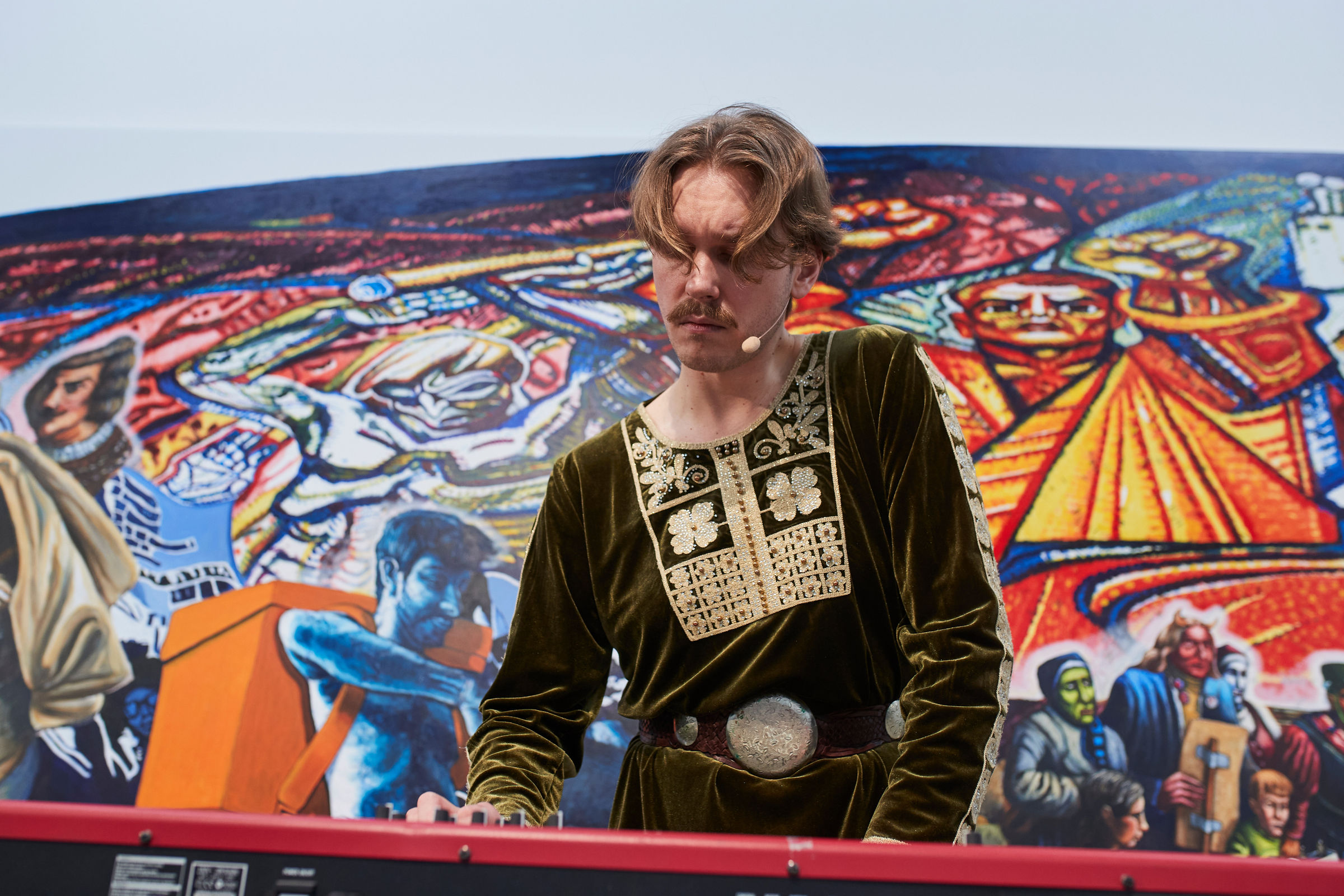
Mikołaj Sobczak
-
Biography

Born 1989 in Poznań, Poland
Lives and works in Amsterdam, Netherlands and Düsseldorf, Germany
Mikołaj Sobczak’s distinctive practice brings together painting, performance, and video to construct alternative histories, centering queer and marginalized figures largely excluded from dominant narratives.
His work will be presented in Family Album at Kunsthuis Syb, The Netherlands (17 October 2026 – 16 January 2027). Sobczak‘s forthcoming and recent exhibitions include Kunsthaus Zürich (opening spring 2027); MANIFESTA 16 Ruhr; Luther Museum, Amsterdam; Polish Institute, Düsseldorf; Moderna Museet, Stockholm; ROZENSTRAAT, Amsterdam; Salzburger Kunstverein; Kunstmuseum Moritzburg, Halle; Jester - Flanders Arts Institute, Genk, Belgium; Ludwig Forum, Aachen; Kunsthalle Münster; Haus der Kulturen der Welt, Berlin; MUDAM, Luxembourg and Museum of Modern Art, Warsaw.
Sobczak’s works are held in the collections of Los Angeles County Museum of Art; Moderna Museet, Stockholm; Kunstsammlung Nordrhein-Westfalen, Düsseldorf; Ludwig Forum, Aachen; The Perimeter, London; Museum of Modern Art, Warsaw and The National Museum, Gdańsk, among others.
In 2021, Sobczak was awarded Poland’s most prestigious art prize, the Paszport Polityki. He was an artist-in-residence at the Rijksakademie van beeldende kunsten, Amsterdam, and took part in the residency program with Art Explora - Cité internationale des arts, Paris. As one of four selected artists, he was awarded the Villa Romana Prize in 2026. Turning to writing as another form of expression, Sobczak published his first book this year, Anti-Fascist Art Manifesto (currently sold out).
-
Installation view: House of Nisaba: New Stories of Painting (Group Show), Moderna Museet, Stockholm, May 14 – August 30, 2026
Mikołaj Sobczak
Parole, Parole, Parole, 2026Oil, acrylic and collage on canvas
220 x 590 cm
86.6 x 232.3 inches -
Together with a group of friends, I travelled to Capri to research queer resistance during the time of Nazi persecution, when the island functioned as a kind of refuge, almost a mythic sanctuary for queer lives.
– Mikołaj SobczakTo listen to the artist as he speaks about his work, click here.
-
-
-
-
-
In times of political radicalization, Sobczak's art invites us to engage with the construction of history.
– Merle Radtke, Kunsthalle Münster
-
-
News
-
Matthew Lutz-Kinoy, Mikołaj Sobczak
'Family Album' (Group Show), Kunsthuis Syb, Beetsterzwaag
October 17, 2026 – January 16, 2027 17 October 2026Kunsthuis Syb is pleased to present Family Album, a group exhibition with newly commissioned and existing works by Ulises Carrión, Sara Sejin Chang (Sara van...Read more -
Mikołaj Sobczak
'Le Cose Hanno Ancora Sete' (Group Show), Villa Romana, Florence
September 19 – November 9, 2026 19 September 2026Some things remain thirsty. Not only bodies, but houses, paintings, photographs, archives, windows, gardens, and stories. They absorb and retain, and they release. They carry...Read more -
Mikołaj Sobczak
Villa Romana Prize 2026 12 June 2025In a year that marks 120 years since the founding of Villa Romana, we are delighted to announce the recipients of the Villa Romana Prize...Read more
-
-
Works
Mikołaj Sobczak
Peasants, 2021Performance with Nicholas GrafiaCommissioned by Haus der Kulturen der Welt, BerlinIn their performance, artists Nicholas Grafia and Mikołaj Sobczak pick up on global historical narratives about exploitation, imperialism and oppression from the point of view of those affected. The title...In their performance, artists Nicholas Grafia and Mikołaj Sobczak pick up on global historical narratives about exploitation, imperialism and oppression from the point of view of those affected.
The title of this work, Peasants, refers to a segment in society that has always been emblematic of exploitation on the one hand and revolutionary forces on the other. In order to convey given interwoven historical and social events, the two artists sometimes draw on the genre of epic theatre. The forty-minute performance takes its starting point at the beginning of the 19th century, at the time of the Haitian Revolution. With the aid of traditional Haitian and Slavic mythologies and sagas, Sobczak and subtly interweave current socio-political discourses with tales from folk belief. Based on this method, they address topics like the imbalance of (co)existence on the global level, various phenomena subsisting beyond the boundaries of mainstream society, groups regarded as stigmatized or the effects of exploitative ideologies of both the past and the present. The artists deliberately play with the understandability of their narratives, not only by speaking different languages, but also by moving through time and space, as it were—like mythical beings navigating between centuries.
Thematically, their performance takes them from ancient Rome to the current border policy of the EU. The music, choreography and costumes are likewise geared toward bringing the stories and traumas of marginalized groups into narrative focus. The performance thus illuminates the origins of structural discrimination and, at the same time, highlights ongoing injustices.Exhibitions
Kunsthalle Münster, Münster, January 2023
Haus der Kulturen der Welt, Berlin, September 2021Exhibitions-
Mikołaj Sobczak
25 June — 1 August 2026
AncoraExplore -
25 for 2025
11 January — 15 February 2025Explore -
Mikołaj Sobczak
Le Boudoir de l'Amour 11 September — 19 October 2024Opening: 11 September, 2:30 - 8 pm Capitain Petzel is pleased to announce Mikołaj Sobczak’s first solo exhibition with the gallery, opening as part of Berlin Art Week on September...Explore -
omelette papier
15 January — 5 March 2022Karla Black, Andrea Bowers, Joe Bradley, Isabella Ducrot, Jadé Fadojutimi, Hadi Fallahpisheh, Anna Gaskell, Georgia Gardner Gray, Stefanie Heinze, Charline von Heyl, Sanya Kantarovsky, Maria Lassnig, Marcel Odenbach, Pieter Schoolwerth,...Explore -
On the Politics of Delicacy
24 January — 22 February 2020The Robert Anton Theatre & Yael Bartana, Duggie Fields, Federico García Lorca, Nicholas Grafia, Hannah Höch, Karolina Jablonska, Krzysztof Jung, Tadeusz Kantor, Stanislava Kovalcikova, Zoe Leonard, Liliane Lijn, Raúl Martínez,...Explore
External ExhibitionsMikołaj Sobczak, Prophet Machine, 2025
ROZENSTRAAT- rose is a rose is a rose, Amsterdam
Press-
Arts of the Working Class: "Art must not wait for victims to die before documenting their struggles" (Mikołaj Sobczak)
Daniel Jonas Roche, 25 August 2026 -
Cahier: "Mikołaj Sobczak"
29 June 2026 -
Il Giornale dell'Arte: 'Quando la pittura diventa archivio: Mikołaj Sobczak da Capitain Petzel'
Margherita Panaciciu, 22 June 2026 -
Rheinische Post: "Überfallen, ausgegrenzt, deportiert – eine Ausstellung über Queerness" (Mikołaj Sobczak)
Claudia Hötzendorfer, 12 June 2026 -
Most Magazine: "Rhyme to Reason: What I Learned from Auguring Art in Salzburg" (Mikołaj Sobczak)
17 September 2025 -
Spike: "Mikołaj Sobczak at Salzburger Kunstverein"
Annalise June Kamegawa, 16 July 2025 -
Vogue Polska: "Vogue Polska” x BMW Art Academy: Contemporary artists are inspired by folklore" (Mikołaj Sobczak)
Marta Czyz, 28 May 2025 -
CULTURE.PL: "‘Familiar Strangers’: A Powerful Exhibition about Eastern Europe at Bozar, Brussels"
Aleksander Kmak, 16 April 2025 -
Artline: "Mikołaj Sobczak: Leibeigene. History in Drag"
Jens Bülskämper, 15 December 2022 -
Frieze: "Mikołaj Sobczak Upends History Painting"
Krzysztof Kościuczuk, 18 November 2022 -
Zacheta: "Demining fear. Mikołaj Sobczak in conversation with Aleksander Kmak"
Mikołaj Sobczak, Aleksander Kmak, 1 August 2021
Publications-

Mikołaj Sobczak
Mikołaj Sobczak. Anti-Fascist Art Manifesto, 2026 2026Hardcover, 48 pagesRead more
Publisher: Walther König
ISBN: 978-3-7533-1053-4 -

Sanya Kantarovsky, Matthew Lutz-Kinoy, Mikolaj Sobczak
House of Nisaba: New Stories of Painting, Moderna Museet, 2026 2026Softcover, 352 pagesRead more
Publisher: Verlag der Buchhandlung Walther und Franz König, Köln
ISBN: 978-3-7533-1003-9
Dimensions: 17 x 23.5 cm
VideoRequest more information