Barbara Bloom
-
Biography

Born 1951 in Los Angeles, CA
Lives and works in New York
Over the course of several decades, Barbara Bloom has developed a distinctive conceptual practice in which objects, images, texts, and spaces form interconnected visual narratives. Drawing on literature, collecting, and the language of museums and display, her multimedia installations invite viewers to discover unexpected relationships between objects and the meanings generated by their juxtaposition.
Bloom will participate in OFFSCREEN at the Chapelle Saint-Louis de la Salpêtrière, Paris (20 – 25 October 2026). She has had institutional solo exhibitions at The Museum of Modern Art, New York; Museum of Contemporary Art, Los Angeles; Serpentine Gallery, London; Martin-Gropius-Bau, Berlin; The Jewish Museum, New York; ZKM, Karlsruhe; and Kunsthal Aarhus, among others. She has also participated in a wide range of group shows, including the Stedelijk Museum, Amsterdam; Hamburger Bahnhof, Berlin; Palais de Tokyo, Paris; Kunsthalle Wien; and Deichtorhallen, Hamburg.
Among her numerous honors and appointments are a Guggenheim Fellowship, a Getty Research Institute Visiting Scholar appointment, and the Venice Biennale Duemila Prize for Best Young Artist.
Bloom’s work is held in major international collections, including The Museum of Modern Art, New York; Dutch National Collection, The Hague; International Center of Photography, New York; Israel Museum, Jerusalem; Museum of Contemporary Art, Los Angeles; Helsinki Museum of Modern Art; Stedelijk Museum, Amsterdam; The Art Institute of Chicago; The New School, New York; ARTER, Istanbul; MAK Museum of Applied Arts, Vienna; and Miami Art Museum.
-
-
-
-
Works
Barbara Bloom
It rained for four years, eleven months, and two days. (Marquez), 2015Hand tufted woollen carpet with carved braille text274 x 183 cm
108 x 72 inchesEdition 2/3B-BBLOOM-16-0008Translation of Braille text: It rained for four years, eleven months, and two days. There were periods of drizzle ... but the people soon grew accustomed to interpret the pauses...Translation of Braille text:
It rained for four years, eleven months, and two days. There were periods of drizzle ... but the people soon grew accustomed to interpret the pauses as a sign of redoubled rain. The sky crumbled into a set of destructive storms and out of the north came hurricanes that scattered roofs about and knocked down walls and uprooted every last plant of the banana groves.
(Gabriel García Márquez, One Hundred years of Solitude, 1967)
Llovió durante cuatro años, once meses y dos días. Hubo períodos de llovizna… pero la gente pronto se acostumbró a interpretar las pausas como un signo de lluvia redoblada. El cielo se derrumbó en una serie de tormentas destructivas y del norte vinieron huracanes que esparcieron los tejados, derribaron paredes y arrancaron hasta la última planta de los platanales.
(Gabriel García Márquez, Cien Años de Soledad, 1967)
Es regnete vier Jahre, elf Monate und zwei Tage. Es gab Zeiten des Nieselregens [...] doch bald gewöhnte man sich daran,
die Regenpausen als Zeichen einer Verschlechterung anzusehen. Aus dem Himmel stürzten sintflutartige Regengüsse,
und der Norden schickte etliche Orkane, die Dächer abdeckten, Wände eindrückten und die letzten Stauden der Pflanzungen mitsamt den Wurzeln ausrissen.
(Gabriel García Márquez, Hundert Jahre Einsamkeit, 1967)News-
Barbara Bloom
'OFFSCREEN' (Group Show), Chapelle Saint-Louis de la Salpêtrière, Paris
October 20 – 25, 2026 20 October 2026For more information, click here .Read more -
Karla Black, Barbara Bloom, Monica Bonvicini, Maria Brunner, Isabella Ducrot, Georg Herold, Charline von Heyl, Zoe Leonard, Laura Owens, Tobias Pils, Stephen Prina, Monika Sosnowska, Christopher Williams
'40 Years Galerie Gisela Capitain' (Group Show), Galerie Gisela Capitain, Cologne
September 4 – October 24, 2026 4 September 2026As part of the 40th anniversary, Galerie Gisela Capitain is pleased to announce a group exhibition presenting works from the gallery's history. Including works by:...Read more -
Barbara Bloom
'The Weather', OHS Old Point Schoolhouse, Orient
June 6 – November 30, 2026 6 June 2026Absence and its depiction are ongoing themes of exploration in the work of Barbara Bloom. Flirtations between visibility and invisibility have made frequent appearances in...Read more
Exhibitions-
25 for 2025
11 January — 15 February 2025Explore -
Sweet Sixteen
Celebrating 16 years of Capitain Petzel 7 June — 3 August 2024On the occasion of Capitain Petzel’s sixteenth anniversary, the gallery is excited to present Sweet Sixteen , a group exhibition celebrating the artists who have been integral to its program...Explore -
Non-Specific Objects
Nairy Baghramian, Barbara Bloom, Monica Bonvicini, David Douard, Nikita Gale, Sanya Kantarovsky, Kristina Nagel, Jack O’Brien, Sin Wai Kin, Alina Szapocznikow, Franz West 20 January — 24 February 2024Capitain Petzel is pleased to announce the group exhibition Non-Specific Objects . The title of the exhibition acts as a counterpoint to the ideas expressed in Donald Judd’s canonical 1964...Explore -
Barbara Bloom
Works on Paper, on Paper 7 March — 1 August 2020Works on Paper, on Paper marks Barbara Bloom’s second exhibition at Capitain Petzel. Composed of two parts, it features the series Stand-Ins in the main gallery space and Objects of...Explore -
Barbara Bloom
The Weather 5 November 2016 — 7 January 2017Please view the dossier to this exhibition here Absence and its depiction has been an ongoing theme of exploration in the work of Barbara Bloom. Fingerprints, lipstick traces, watermarks, tea...Explore
External ExhibitionsBarbara Bloom, ...the whole grand pattern of human endeavor, 2023
Galerie Gisela Capitain, Cologne
Press-
Artforum: "Barbara Bloom Zweigstelle Capitain VI – Palazzo Degas"
Cornelia Lauf, 1 December 2024 -
ArtReview: "Delinquent Bodies, Non-Specific Objects"
Jasmine Reimer, 26 April 2024 -
ARTnews: "Artist Barbara Bloom and Writer Ben Lerner Invent a New Kind of Book"
Shanti Escalante-De Mattei, 28 July 2022 -
The Brooklyn Rail: "Barbara Bloom with Tom McGlynn"
Tom Glynn, 14 June 2021
Publications-

Barbara Bloom and Ben Lerner
Gold Custody, 2021 2021 Read more -

Ross Bleckner, Barbara Bloom, Troy Brauntuch, Matt Mullican, Stephen Prina, Christopher Williams
Kunsthaus Graz, Kestnergesellschaft, Hannover, 2020 2020Softcover, 176 pagesRead more
Publisher: Kunsthaus Graz, Kestnergesellschaft, Hannover
ISBN: 978-3-903179-23-3
Dimensions: 15 x 21 cm -

Barbara Bloom
Gifts, 2015 2015Hardcover, 112 pagesRead more
Publisher: Ludion
ISBN: 9789491819490
Dimensions: 16 x 24 cm -

Barbara Bloom
As It Were … So to Speak, Jewish Musuem, New York, 2015 2015Hardcover, 144 pagesRead more
Publisher: Jewish Museum, New York
Dimensions: 16,5 x 24,1 cm -

Barbara Bloom
Between Artists: Barbara Bloom & John Baldessari, 2011 2011Softcover, 60 pagesRead more
Publisher: (A.R.T.) Press, New York
ISBN: 9780923183479
Dimensions: 12.7 x 19 cm -
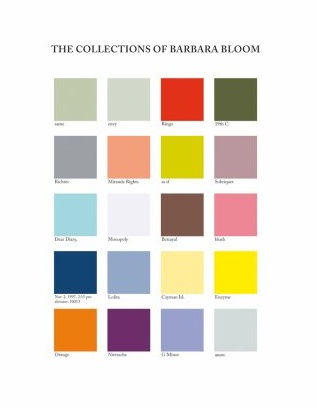
Barbara Bloom
The Collections of Barbara Bloom, Steidl, 2008 2008Hardcover, 272 pagesRead more
Publisher: Steidl/ICP
ISBN: 9783865216212
Request more information


